
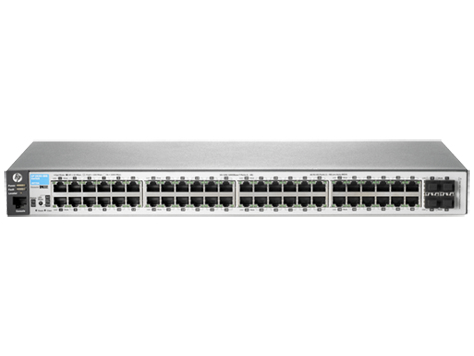
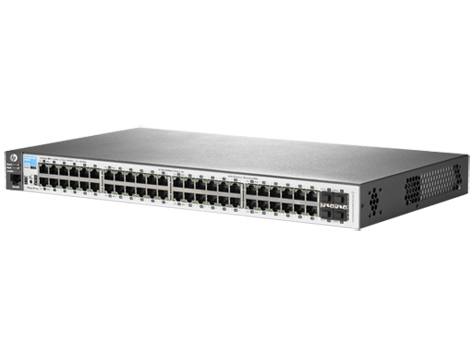
HPE 2530-48G Vezérelt L2 Gigabit Ethernet (10/100/1000) 1U
- Brand: HPE
- Category:
- SKU: J9775-61001
- EAN:
HP 2530-48G Switch
Offer details
Trade Prices
| Distributor | Product | SKU | Stock | Updated | Price |
|---|---|---|---|---|---|

|
Aruba 2530 48G Switch |
J9775-61001 |
Related Products
-
 Category: Halózati adó-vevő modulok
 -
 Category: Halózati adó-vevő modulok
-
 Category: Rack tartozékok
Description
The HP 2530 Switch Series consists of 12 fully managed Layer 2 edge switches that deliver cost-effective, reliable, secure, and easy-to-use connectivity to business networks. Designed for entry-level to midsize enterprise networks, these Gigabit and Fast Ethernet switches deliver full Layer 2 capabilities with optional PoE+, enhanced access security, traffic prioritization, and IPv6 host support. The HP 2530 Switch Series offers uplink flexibility with four Gigabit Ethernet uplinks on all 24- and 48-port models. Gigabit Ethernet uplinks are four small form-factor pluggable (SFP) slots for fiber connectivity on the 24- and 48-port Gigabit Ethernet models. The Fast Ethernet 24- and 48-port models have two SFPs and two RJ-45 Gigabit uplinks. The compact and fanless 8-port switches offer additional flexibility with two dual-personality ports that can be used as either RJ-45 Gigabit Ethernet or SFP ports. For customers implementing Power over Ethernet for voice, video, or wireless deployments, the HP 2530 PoE+ switches are IEEE 802.3af and IEEE 802.3at compliant with up to 30 W per port. The switch series is easy to use, deploy, and manage via SNMP, CLI, and Web GUI. It offers flexible wall, table, and rack mounting; quiet operation with fanless and variable speed fan models; and improved power savings, with features such as IEEE 802.3 az (Energy Efficient Ethernet). These switches include a lifetime warranty, as well as all software releases and technical phone support.
Quality of Service (QoS)
• Traffic prioritization (IEEE 802.1p): allows real-time traffic classification with support for eight priority levels mapped to either two or four queues; uses weighted deficit round robin (WDRR) or strict priority (SP)
Management
• Choice of management interfaces: Web graphical user interface (GUI): HTML-based easy-to-use graphical interface allows configuration of the switch from any Web browser. Command-line interface (CLI): provides advanced configuration and diagnostics through a robust CLI. Simple Network Management Protocol (SNMPv1/v2c/v3): allows a switch to be managed with a variety of third-party network management applications.
Connectivity
• IPv6: IPv6 host: allows the switch to be deployed and managed at the edge of an IPv6 network. Dual stack (IPv4/IPv6): supports connectivity for both protocols; provides a transition mechanism from IPv4 to IPv6. MLD snooping: forwards IPv6 multicast traffic to the appropriate interface; prevents IPv6 multicast traffic from flooding the network.
Layer 2 switching
• VLANs: provides support for 512 VLANs and 4,094 VLAN IDs
Security
• Access control lists (ACLs): accommodates IPv4/IPv6 port and VLAN-based ACLs (IPv6 ACL is supported only on Gigabit Ethernet and 48-port models)
Convergence
• LLDP-MED (Media Endpoint Discovery): defines a standard extension of LLDP that stores values for parameters such as QoS and VLAN to automatically configure network devices such as IP phones
Resiliency and high availability
• Port trunking and link aggregation: Trunking: supports up to eight links per trunk to increase bandwidth and create redundant connections; supports L2, L3, and L4 trunk load-balancing algorithm (L4 trunk load balancing is supported only on Gigabit Ethernet and 48-port models). IEEE 802.3ad Link Aggregation Protocol (LACP): eases configuration of trunks through automatic configuration.
Quality of Service (QoS)
• Traffic prioritization (IEEE 802.1p): allows real-time traffic classification with support for eight priority levels mapped to either two or four queues; uses weighted deficit round robin (WDRR) or strict priority (SP)
Management
• Choice of management interfaces: Web graphical user interface (GUI): HTML-based easy-to-use graphical interface allows configuration of the switch from any Web browser. Command-line interface (CLI): provides advanced configuration and diagnostics through a robust CLI. Simple Network Management Protocol (SNMPv1/v2c/v3): allows a switch to be managed with a variety of third-party network management applications.
Connectivity
• IPv6: IPv6 host: allows the switch to be deployed and managed at the edge of an IPv6 network. Dual stack (IPv4/IPv6): supports connectivity for both protocols; provides a transition mechanism from IPv4 to IPv6. MLD snooping: forwards IPv6 multicast traffic to the appropriate interface; prevents IPv6 multicast traffic from flooding the network.
Layer 2 switching
• VLANs: provides support for 512 VLANs and 4,094 VLAN IDs
Security
• Access control lists (ACLs): accommodates IPv4/IPv6 port and VLAN-based ACLs (IPv6 ACL is supported only on Gigabit Ethernet and 48-port models)
Convergence
• LLDP-MED (Media Endpoint Discovery): defines a standard extension of LLDP that stores values for parameters such as QoS and VLAN to automatically configure network devices such as IP phones
Resiliency and high availability
• Port trunking and link aggregation: Trunking: supports up to eight links per trunk to increase bandwidth and create redundant connections; supports L2, L3, and L4 trunk load-balancing algorithm (L4 trunk load balancing is supported only on Gigabit Ethernet and 48-port models). IEEE 802.3ad Link Aggregation Protocol (LACP): eases configuration of trunks through automatic configuration.
Specifications
| Menedzsment funkciók | |
|---|---|
| Kapcsoló típusa | Vezérelt |
| Kapcsoló réteg | L2 |
| Webalapú kezelés | Igen |
| Szolgáltatási minőség (QoS) támogatás | Igen |
| Többszörös sugárzási támogatás | Igen |
| MIB-támogatás | Yes |
| Csatlakozók és csatlakozási felületek | |
| Alapvető kapcsolási RJ-45 Ethernet portok száma | 48 |
| Alapvető kapcsolási RJ-45 Ethernet portok típusa | Gigabit Ethernet (10/100/1000) |
| SFP modul bővítőhelyek száma | 4 |
| Hálózat | |
| Hálózati szabvány | IEEE 802.3, IEEE 802.3ab, IEEE 802.3u |
| Teljes kétoldalú | Igen |
| VLAN támogatás | Igen |
| Szétválási fa protokoll | Igen |
| Sebességkorlátozás | Igen |
| Porttükrözés | Igen |
| Link-aggregáció | Igen |
| Folyamatszabályozás támogatás | Igen |
| Automatikus érzékelés | Igen |
| Automata MDI/MDI-X | Igen |
| 10G támogatás | Nincs |
| Adatátvitel | |
| MAC-címtábla | 16000 bejegyzés(ek) |
| Kapcsolási kapacitás | 104 Gbit/s |
| Áteresztőképesség | 77,3 Mpps |
| Várakozási idő (10-100 Mbps) | 7,4 µs |
| Várakozási idő (1 Gbps) | 2,3 µs |
| Csomag buffer memória | 3 MB |
| Biztonság | |
| SSH/SSL támogatás | Igen |
| Hozzáférési vezérlő lista (ACL) | Igen |
| Multicast funkciók | |
| Többszörös sugárzási támogatás | Igen |
| Kialakítás | |
| Keretállvány | Igen |
| Egymáshoz köthető | Igen |
| Külső megjelenés | 1U |
| Teljesítmény | |
| Processzor frekvencia | 800 MHz |
| Memória típusa | DDR3-SDRAM |
| Belső memória | 256 MB |
| Flash memória | 128 MB |
| Beépített processzor | Igen |
| Processzor modell | ARM9 |
| Egymáshoz köthető | Igen |
| Csomag buffer memória | 3 MB |
| Tápellátás | |
| AC bemeneti feszültség | 100 - 240 V |
| AC bemeneti frekvencia | 50 - 60 Hz |
| Áramfogyasztás (tipikus) | 59,5 W |
| Tápellátás Etherneten keresztül (PoE) | |
| Ethernet-áramellátás (PoE) támogatása | Nincs |
| Üzemi körülmények | |
| Hőleadás | 203 BTU/h |
| Virtuális LAN-funkciók | |
| VLAN támogatás | Igen |
| Tömeg és méretek | |
| Szélesség | 443 mm |
| Mélység | 254 mm |
| Magasság | 44,5 mm |
| Tömeg | 3,08 kg |